
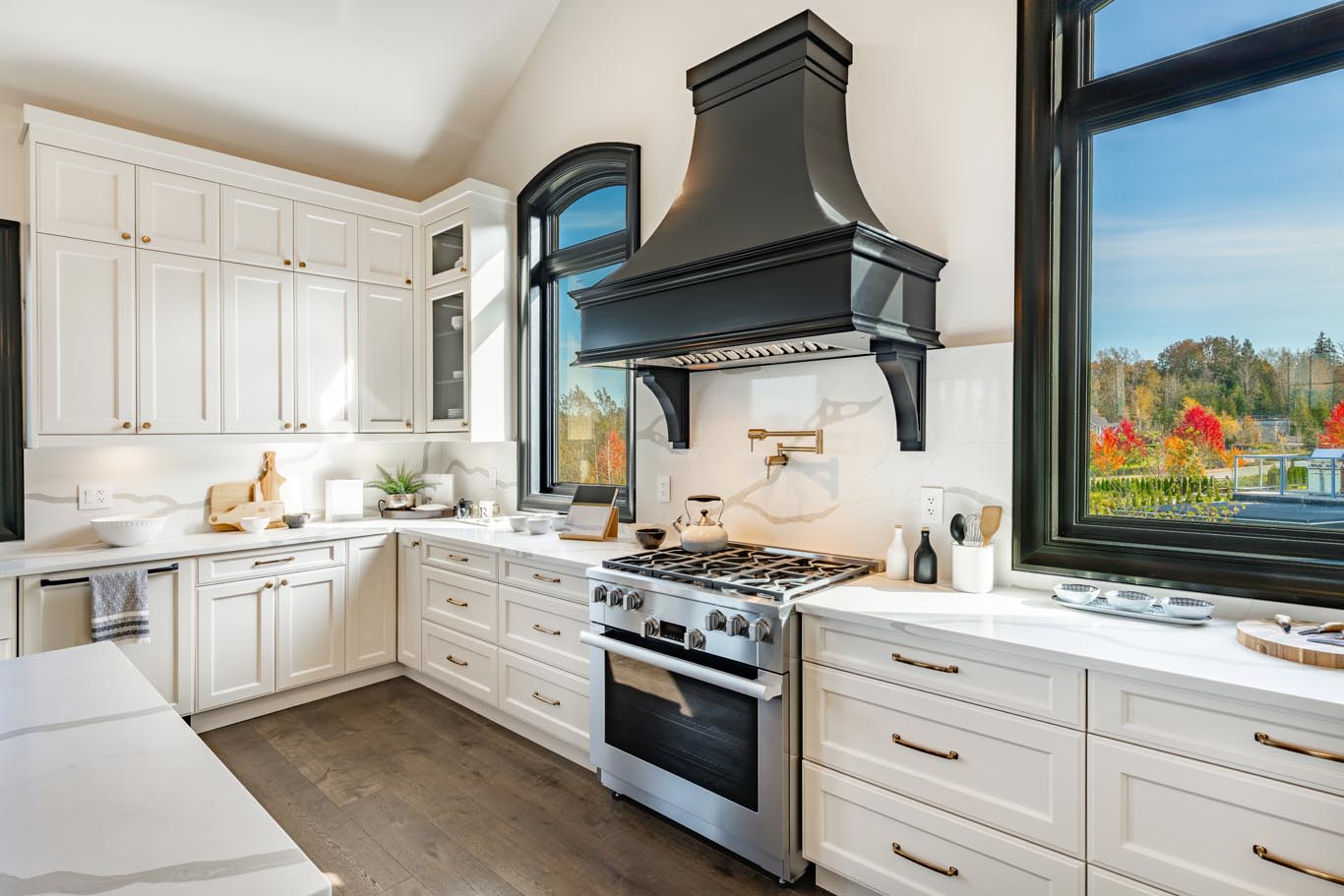
Construction Specifications: How Are Your Cabinets Constructed?
The quality of cabinetry begins long before the finish is applied or the doors and hardware are installed. It begins with construction: the materials selected, the way cabinet boxes are engineered, the strength of the joinery, the precision of the fit, and the hardware used to support years of daily operation.
We believe well-built cabinets should provide more than an attractive exterior. They should remain square, stable, functional, and beautiful through years of opening, closing, loading, cleaning, and everyday use. Our cabinet construction specifications focus on structural integrity, quality materials, precise fabrication, dependable hardware, and carefully finished details.
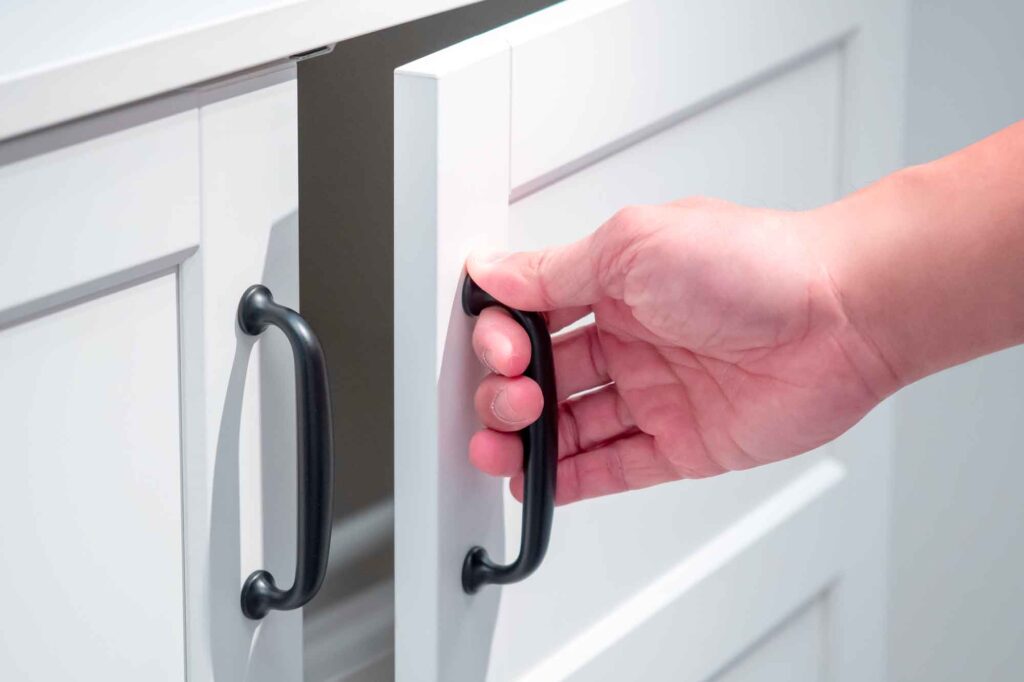
Understanding how cabinets are constructed also makes it easier to compare cabinetry based on meaningful differences rather than appearance alone. Two cabinets may look nearly identical from across a room while being very different in materials, structural strength, drawer construction, hardware, and long-term durability.
Cabinet Construction Starts with the Cabinet Box
The cabinet box, sometimes called the cabinet case or carcass, forms the structural foundation of the cabinet. Doors, drawers, shelves, hinges, and interior fittings all depend on a box that is accurately constructed and capable of maintaining its shape under load.
A properly constructed cabinet box must resist twisting, sagging, and racking. This is especially important for wide base cabinets, wall cabinets carrying dishes or cookware, tall pantry cabinets, and cabinets supporting heavy countertops.
We pay particular attention to the thickness and composition of cabinet components, the method used to join them, the strength of the back, and the way shelves and hardware are supported. These elements determine how the cabinet performs after installation—not merely how it looks on the day it is installed.
Plywood Cabinet Construction
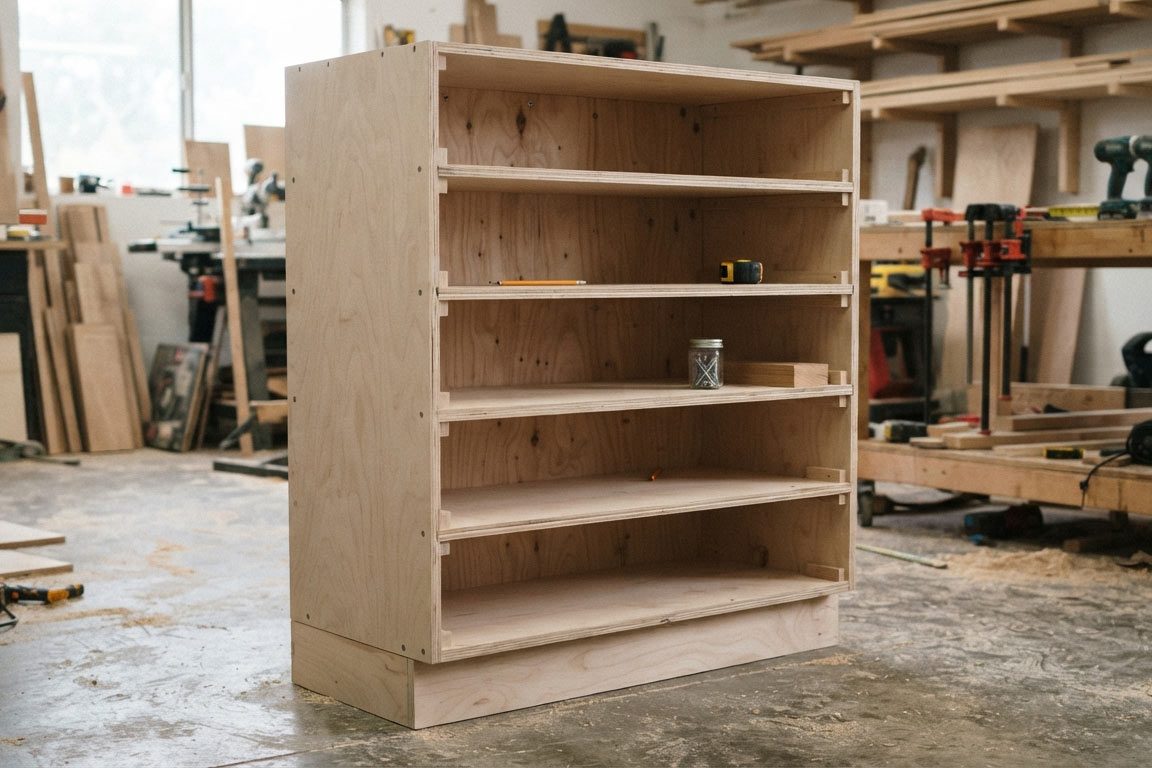
Plywood is widely valued in quality cabinet construction because it combines strength, dimensional stability, and relatively low weight. Cabinet-grade plywood is manufactured from multiple layers, or plies, of wood veneer bonded together with the grain direction alternating between layers. This cross-laminated construction helps the panel resist warping and movement.
Quality plywood is particularly useful for cabinet sides, bottoms, tops, backs, and shelves. Its layered construction provides excellent screw-holding ability, which is important wherever hinges, drawer slides, mounting hardware, or other components are mechanically fastened to the cabinet.
Not all plywood, however, is equivalent. The number and quality of the plies, veneer quality, core construction, adhesives, thickness, and presence of internal voids can all affect performance. For cabinetry, we favor materials selected specifically for furniture and cabinet applications rather than general-purpose construction panels.
Plywood vs. Particleboard Cabinet Construction
One of the most common questions when comparing cabinets concerns plywood versus particleboard construction. Both materials can be used successfully when they are appropriately engineered for the application, but their physical characteristics differ.
Plywood derives much of its strength from laminated wood veneers. Particleboard is an engineered panel manufactured by combining wood particles with resin and compressing the material under heat and pressure.
The distinction becomes particularly important around fasteners, moisture exposure, cabinet weight, and structural loading. Plywood provides excellent strength relative to its weight and strong mechanical fastening characteristics. Particleboard is typically denser and heavier, easier to damage, and swells permanently if it absorbs water.
Cabinet Joinery and Structural Integrity
Good materials alone do not guarantee a good cabinet. The way individual components are joined has an equally important effect on strength and durability.
Cabinet construction may incorporate dadoes, rabbets, dowels, mortise-and-tenon joints, screws, confirmat fasteners, specialized connectors, adhesives, or combinations of several methods. The appropriate technique depends on the cabinet design and materials.
Precision is critical. Joints should fit accurately and consistently so loads are distributed through the cabinet structure. Poorly aligned or loosely fitted components can allow movement, causing doors and drawers to drift out of adjustment and creating unnecessary stress on hardware.
Our goal is a cabinet structure that functions as a unified assembly. The cabinet should remain square and rigid while supporting the loads associated with normal residential use.
Framed vs. Frameless Cabinet Construction
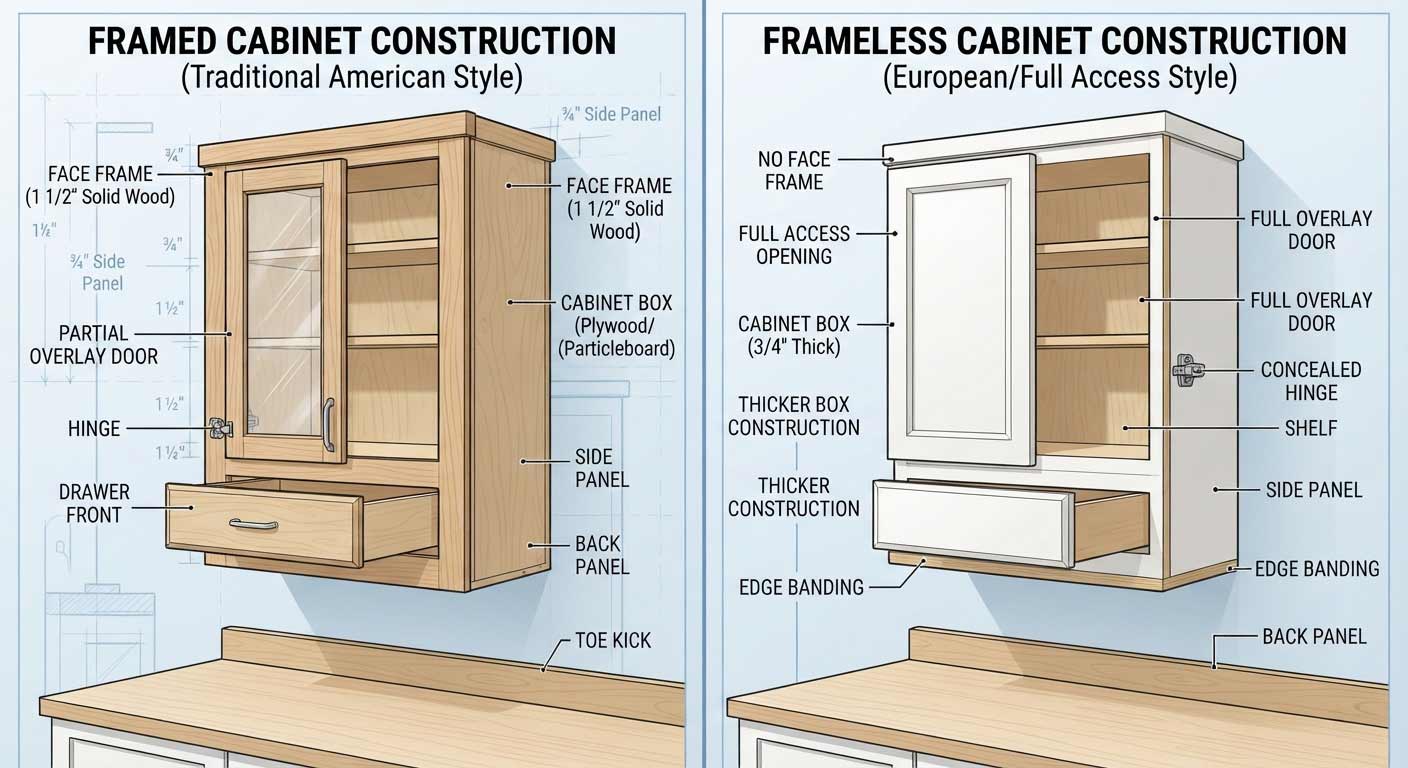
Cabinets are generally built using either framed or frameless construction. Both approaches can produce excellent cabinetry, but they differ structurally and aesthetically.
Framed Cabinets
Traditional framed cabinetry incorporates a face frame attached to the front of the cabinet box. The frame typically consists of horizontal rails and vertical stiles and adds rigidity to the front of the cabinet.
Doors and drawer fronts are arranged in relation to this frame. Depending on the design, they may partially overlay the frame, fully overlay it, or sit inset within the openings.
Framed construction is closely associated with traditional American cabinetry and works particularly well for designs where the face frame itself contributes to the visual character of the cabinetry.
Frameless Cabinets
Frameless cabinetry eliminates the traditional front face frame. The cabinet sides form the front edges of the box, and doors and drawer fronts attach directly to the cabinet case.
This construction method can provide wider interior access because there is no center stile or surrounding face frame occupying the opening. Frameless cabinets are often associated with contemporary and European-inspired design, although they can accommodate a broad range of door styles.
Because the cabinet box itself provides the structure, accurate machining, strong panel materials, reliable joinery, and proper installation are especially important.
Cabinet Door Construction
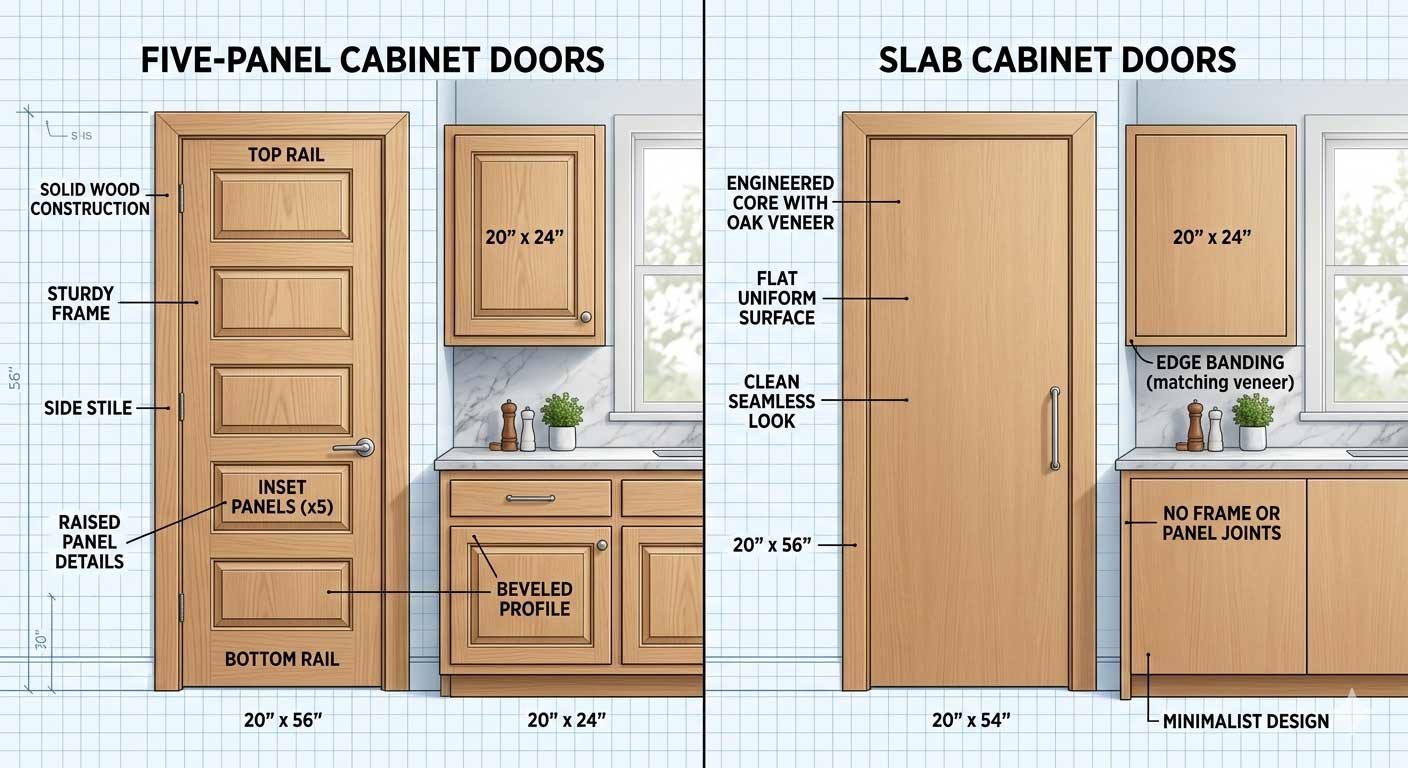
Cabinet doors have an enormous influence on appearance, but their construction also affects stability and longevity. Door design generally falls into several categories, including five-piece frame-and-panel doors and slab doors.
Five-Piece Cabinet Doors
A traditional five-piece cabinet door consists of two vertical stiles, two horizontal rails, and a center panel. The frame provides structure while the center panel creates the primary visual field of the door.
Depending on the design, the center may be flat or raised. Profiles can range from restrained Shaker-style detailing to more elaborate traditional molding.
Wood is hygroscopic, meaning it naturally responds to changes in environmental humidity. Traditional frame-and-panel construction accommodates this characteristic by allowing the center panel to move independently within the surrounding frame.
Slab Cabinet Doors
Slab doors create a clean, uninterrupted surface and are particularly effective in contemporary cabinetry. Depending on the design and finish, slab doors may use engineered cores with wood veneer, laminate, acrylic, painted surfaces, or other decorative materials.
Material stability becomes especially important with large slab doors because a broad, uninterrupted panel must remain flat over its entire surface.
Drawer Box Construction
Drawers are among the hardest-working components in a kitchen, bathroom, office, or built-in storage system. They may be opened thousands of times and routinely carry substantial loads. Drawer construction therefore deserves careful consideration.
A quality drawer requires strong sides, secure corners, a properly supported bottom, accurate dimensions, and hardware matched to the expected load.
Dovetail Drawer Construction
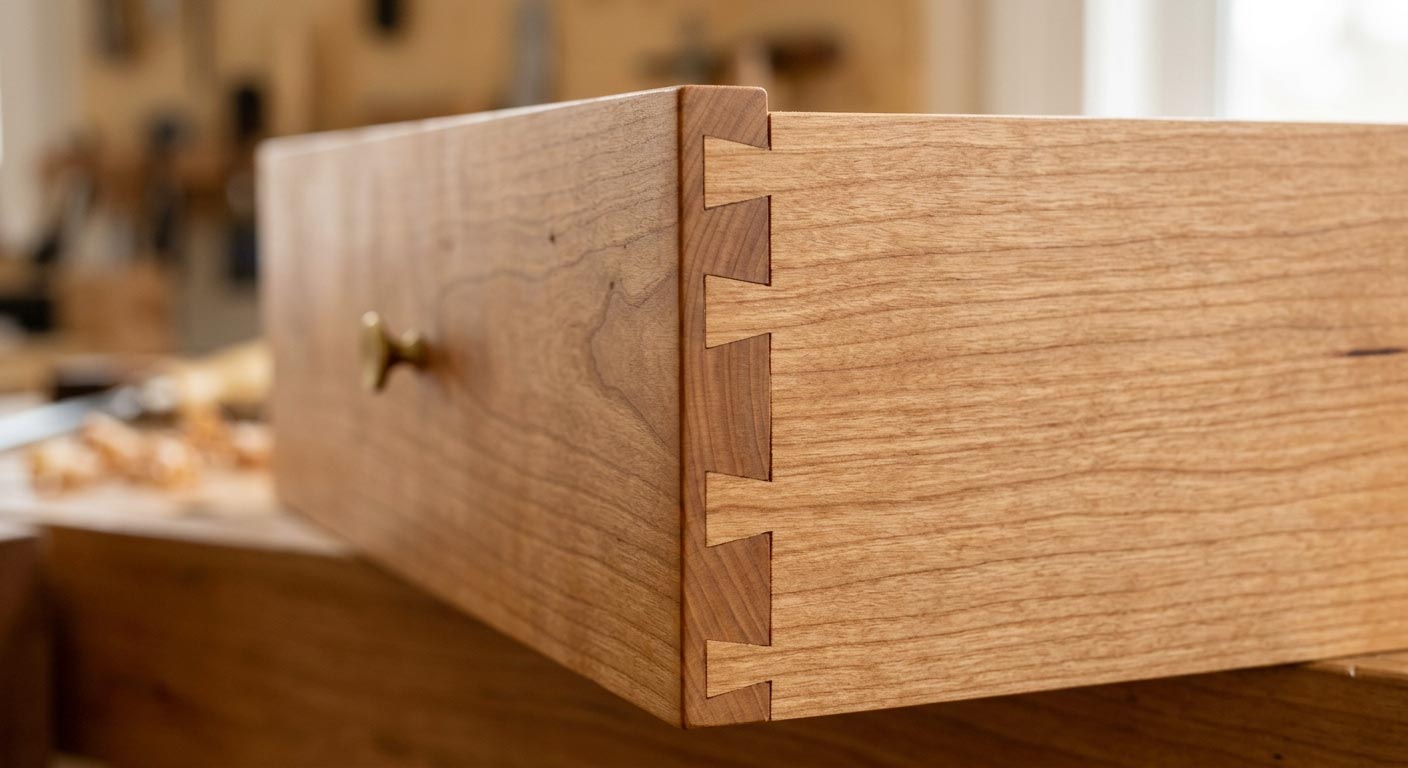
Dovetail joints are a traditional method of joining drawer sides to drawer fronts and backs. The interlocking geometry of the joint provides mechanical strength and a large bonding surface.
Well-executed dovetail construction is both functional and visually distinctive. The joint has long been associated with furniture and cabinetmaking because it resists the pulling forces generated as a drawer is repeatedly opened.